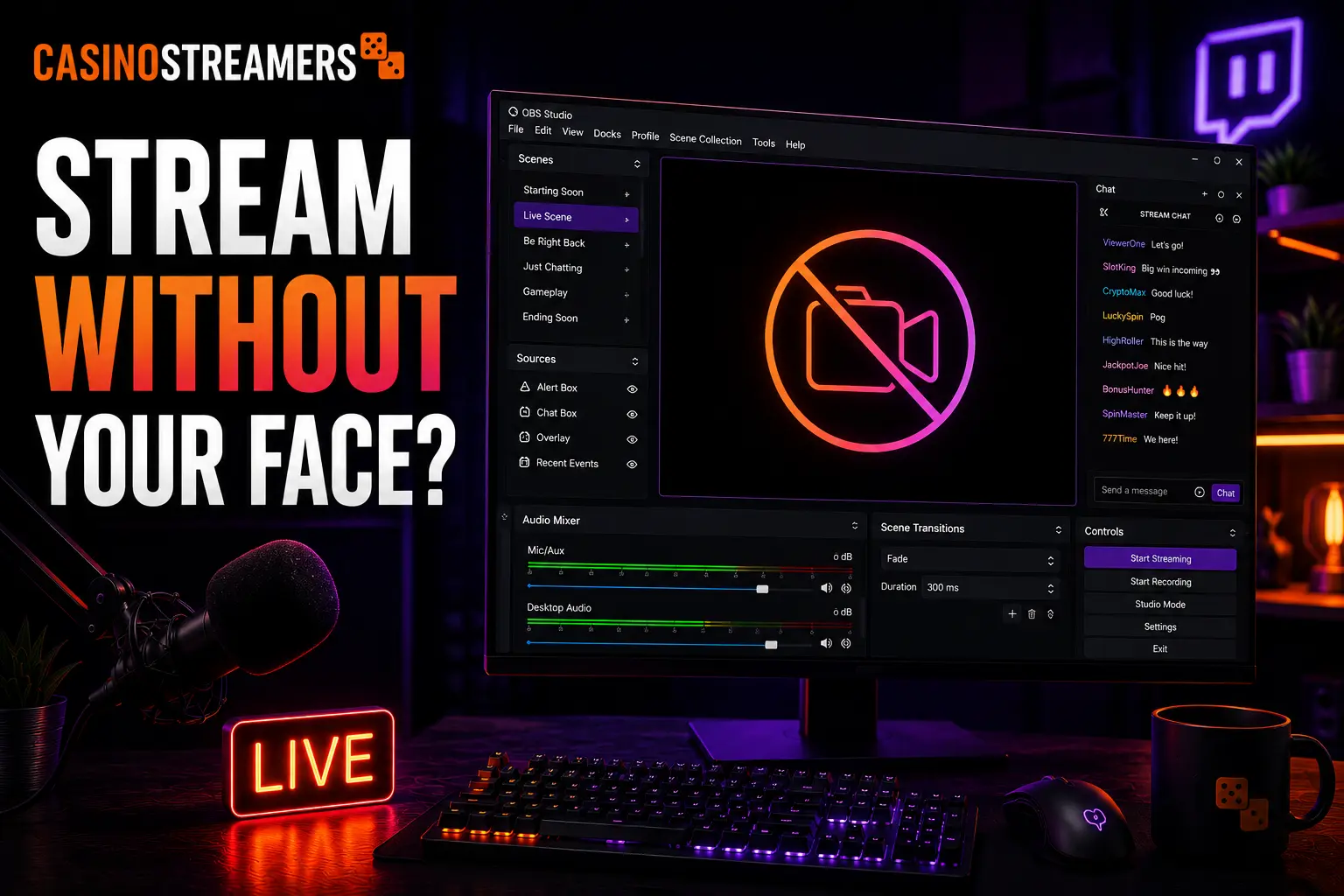
The faceless streaming and content market has grown fast enough that 72% of Gen Z viewers now say they care more about content quality than whether they can see the creator's face. The tools have never been better. In most categories going faceless is a style choice. In casino streaming, viewers are already asking whether the money is real and whether the reactions are genuine. A face answers both questions. Without one, you are starting from a harder position.
Why Streamers Drop the Face Cam
Camera anxiety is the most common reason, but it is not the only one. Privacy is a legitimate concern for anyone whose day job might not look kindly on a gambling content channel. Jurisdiction matters too. In some regions streaming casino content sits in a legal grey zone and keeping your face off screen keeps your real identity separate from the content.
Some new streamers simply do not want a permanent video record of themselves gambling on the internet. That is also a reasonable place to start.
Your Face Is a Product Decision
The format you choose is not just a technical decision. It determines what viewers attach to and how much trust they extend before you have earned it.
Voice-only is the lowest friction entry point. No camera, no avatar software, just OBS and a microphone. You can start streaming on Kick today with nothing but a USB mic. The catch is that poor audio kills retention faster than anything else. Without a face, your voice is the entire product. A cheap microphone in an untreated room ends streams before they start.
PNGtubers use a static or slightly animated image that reacts when you talk. Software like veadotube mini handles the animation, OBS handles the rest. Setup takes an hour. The image becomes your identity and viewers attach to it faster than you might expect.
VTubers use a fully animated 3D or 2D avatar that tracks your facial expressions in real time. VTube Studio is the standard software, and the minimum viable setup is a webcam, VTube Studio and OBS at 60fps. Avoid default avatars. A generic character signals to viewers that the channel is not serious. Commission something basic but distinct.
AI face swap tools like DeepFaceLive replace your face with a generated face in real time, with your expressions still driving the output through a virtual camera into OBS. GPU-intensive and worth testing before going live. The result is the closest to conventional streaming without showing your actual face.
How Faceless Streamers Actually Grow
The clip funnel is not optional, it is the whole strategy. A faceless slot streamer sitting at 10-20 concurrent viewers is not going to grow through live tipping spikes the way a face-cam channel does. The live stream builds the VOD, the VOD becomes the clip, the clip finds someone on TikTok or YouTube Shorts who did not know the channel existed.
That person shows up to the next live session. Face-cam streamers get reaction content and emotional moments that travel on their own. Faceless streamers manufacture that pipeline deliberately or they do not grow.
What replaces the face in chat is effort. Calling out names early, responding to everything in the first half hour, making people feel like the stream noticed them. It sounds simple because it is simple. Most streamers do not do it consistently enough for it to compound.
On-screen overlays carry more weight without a face on screen. A visible session balance, a loss tracker, an active chat display keep something happening visually when there is nothing else to look at.
The best tools for new streamers covers the clipping and analytics tools that make this model work in practice.
Casino Streaming Without a Face: Where It Gets Harder
Casino streaming has a trust problem that most streaming categories do not. Viewers already arrive skeptical about whether the money on screen is real and whether the reactions are genuine. A face-cam streamer landing a 5,000x hit with a visible reaction is hard to fake. A voice-only or avatar streamer landing the same win gives viewers nothing to anchor that reaction to. The fake money debate that already follows casino streaming lands harder on faceless channels because anonymity reads as evasion to an already skeptical audience.
There is a legitimate reason to stream casino content faceless that goes beyond camera anxiety. Someone who streams Valorant without a face is protecting their privacy. Someone who streams casino content without a face may also be protecting their livelihood. Those are different things and worth naming separately.
Kick is the most faceless-friendly platform for this. No face-cam requirements, no restrictions on anonymous streaming, and the 95/5 subscription split means every subscriber matters more than it would elsewhere.
The casino streams running on Kick right now include both face-cam and faceless creators.
The Tradeoff Nobody Mentions
Most donations happen on peaks. Big wins, big losses, tilt reactions after a bad run. Those are the moments that convert a passive viewer into someone who actually tips. If no one can see you, those moments land weaker. A visible face processing a 200x bonus generates a response that a voice saying "oh that's not bad" does not. Tipping behaviour is strongly tied to visual reaction, and without it the ceiling on live donation income is lower.
That is not a reason to stay on camera if camera is not the right choice for you. It is a reason to go in with accurate expectations rather than the ones most faceless streaming guides hand out. Faceless works. It just works slower, and anyone telling you otherwise is selling something.
References
- 72% of Gen Z viewers now say they care more about content quality than whether they can see the creator's face (https://www.contentgrip.com/the-rise-of-faceless-creators/)