
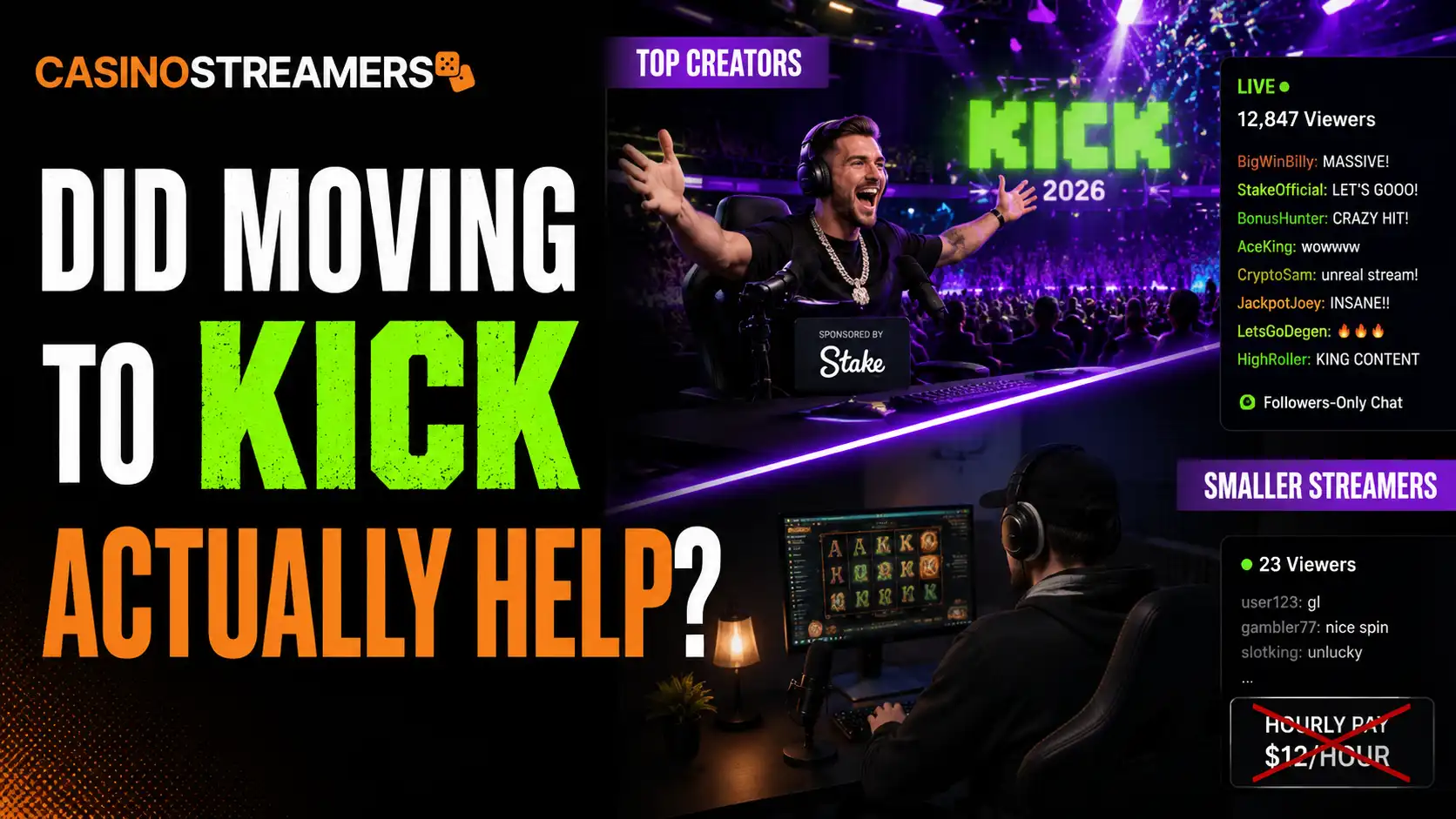
When Twitch cracked down on unlicensed gambling sites in October 2022, some of its biggestcasino streamers suddenly needed somewhere else to go. Kick arrived weeks later, backed by the same people behind Stake and offering something Twitch couldn't: a platform willing to host the kind of casino content it had just restricted.
On paper, the deal looked almost absurdly good. Streamers kept 95% of subscription revenue, gambling remained welcome, and Kick started throwing serious money at creators willing to help build the platform.
Nearly four years later, we have enough evidence to ask the question that actually matters: did moving to Kick work?
For the biggest casino streamers, absolutely. For smaller creators, the answer is much less convincing. Kick became the main home of high-volume casino streaming, but the platform that exists in 2026 isn't offering quite the same deal it used to.
Why Casino Streamers Moved From Twitch to Kick
The exodus started with Twitch.
In September 2022, streamer Sliker admitted he had scammed friends and other creators out of more than $200,000 while struggling with gambling. The revelation poured fuel on an argument that had already been running across Twitch, with major creators including Pokimane and Mizkif publicly pushing the platform to act.
Twitch announced new gambling restrictions days later.
From October 18, streams featuring slots, roulette or dice from sites that weren't licensed in the US or another jurisdiction Twitch considered sufficiently protective of consumers were prohibited. Stake, Rollbit, Duelbits and Roobet were among the sites specifically named. Poker, fantasy sports and sports betting remained permitted.
That distinction matters. Twitch didn't ban gambling entirely, but it effectively removed the offshore casino ecosystem that had produced many of its biggest gambling streams.
Kick launched publicly in December 2022. Its founders, Ed Craven and Bijan Tehrani, were already the co-founders of Stake, while Trainwreckstv became one of Kick's earliest and most vocal supporters.
The timing couldn't have been better. Twitch had just created a homeless group of creators with large audiences and lucrative casino partnerships. Kick gave them somewhere to take both.
Kick vs Twitch: The Money Looked Much Better
The easiest part of the argument for Kick is still its subscription split.
Kick's famous 95/5 model means a creator keeps roughly $4.74 from a $4.99 subscription before applicable fees. Twitch's standard subscription split has historically been closer to 50/50 for most creators.
At 1,000 equivalent $4.99 subscriptions, that's roughly $4,740 on Kick against about $2,500 under a straight 50/50 split.
That's real money. It's also only one part of the business.
The 95/5 split applies to subscriptions, not a casino streamer's entire income. For established gambling creators, operator sponsorships and affiliate agreements can be worth considerably more than platform subscriptions. A better sub split is useful, but it doesn't automatically mean Kick pays a casino streamer twice as much as Twitch would have.
There's another problem with the comparison: revenue share only tells you how a pie gets divided. It doesn't tell you how big the pie is.
A streamer who retains 95% of 200 subscriptions can still make less than one retaining 50% of 1,000. Moving platforms means moving audiences, and not every viewer follows.
For casino streamers there was another complication. Many weren't choosing between identical opportunities on Twitch and Kick because the casino sites at the centre of their streams could no longer be shown on Twitch.
Kick wasn't simply offering them a better deal.
For some, it was offering them the only major livestreaming platform where their existing format could continue largely intact.
Kick Became the Main Home of Casino Streaming
If the goal was simply to preserve casino streaming after Twitch's restrictions, the move worked.
By H1 2026, Streams Charts described Kick as the primary home of high-volume casino broadcasters, with its ranking of the top 500 Slots & Casino creators showing the platform dominating the top of the category.
Stake's presence is particularly hard to miss. Stream Hatchet data reported in March 2026 found the operator appeared in around 60% of tracked iGaming brand mentions across livestreaming, while Trainwreckstv alone generated 15.7 million hours of iGaming watch time on Kick.
Casino streaming didn't disappear when Twitch tightened its rules. It concentrated somewhere else.
That's arguably Kick's biggest success. Instead of competing with every gaming category for space on Twitch, casino streamers ended up on a platform where gambling became one of the defining parts of the ecosystem.
But Kick itself remains considerably smaller than Twitch.
Stream Hatchet recorded roughly 1.3 billion hours watched on Kick in Q1 2026 compared with around 4.5 billion on Twitch. Exact market-share percentages vary depending on which livestreaming platforms are included in the comparison, but the important part for creators is much simpler: Kick has grown enormously without catching Twitch's overall audience.
That creates the central trade-off of the entire migration. Casino has a much stronger position within Kick, but Kick has a smaller overall audience to discover it.
The $16-an-Hour Safety Net Disappeared
This is where the original Kick proposition starts looking different.
Kick's Partner Program gave eligible creators an hourly payment for streaming. For smaller and mid-sized creators, that mattered because income wasn't entirely dependent on subscriptions, donations or sponsorships.
Then casino streamers lost it.
In March 2025, Kick removed the Slots & Casino category from its Partner Program hourly payouts. Eligible creators had reportedly been receiving around $16 per streaming hour. They could continue earning through subscriptions and other sources, but hours spent broadcasting casino content no longer qualified for that platform-funded payment.
Kick's current creator documentation is even clearer: monetisation through the program isn't available in the Slots & Casino category.
For Trainwreckstv or Roshtein, $16 an hour isn't deciding whether the month went well.
For somebody trying to turn 20 viewers into 50, it's a very different calculation. Stream 100 hours a month and the old $16 rate represented roughly $1,600 before a single subscription, tip or affiliate conversion.
The uncertainty wasn't limited to casino creators either. In late 2025, creators including Adin Ross publicly complained about sharp reductions in Kick payouts after the platform changed how it measured legitimate viewership and removed inflated or botted traffic from calculations. Kick maintained that the underlying pay rate hadn't simply been slashed, but the episode showed how dependent creator income remained on rules the platform itself could change.
That's an important dividing line in this story.
Kick still gives casino streamers somewhere to broadcast. It no longer pays them simply for filling that category with content.
Did the Biggest Casino Streamers Benefit From Kick?
At the top end, there's barely an argument.
Kick's early creator spending produced deals rarely seen anywhere in livestreaming.
xQc signed a two-year non-exclusive agreement in 2023 reportedly worth $70 million guaranteed, with incentives capable of taking it to $100 million. The non-exclusive part was almost as remarkable as the number: he was still free to stream on Twitch.
Trainwreckstv has claimed that his Stake relationship generated $360 million over 16 months. That figure has never been independently verified, so it shouldn't be treated like an audited earnings statement, but it gives some idea of the scale being discussed around the very top of casino streaming.
Roshtein remains among Kick's most prominent dedicated casino creators, while creators such as Maherco and ClassyBeef continue generating substantial audiences in the category.
These aren't examples of creators who moved to Kick and disappeared.
The top of casino streaming successfully rebuilt itself there.
The catch is that these people are terrible benchmarks for a new streamer.
Kick's biggest creators arrived with audiences, sponsor relationships and negotiating power already attached. Some were being paid specifically because Kick needed recognizable names capable of persuading viewers to try a platform most of them had never used.
A creator starting from zero in 2026 isn't being offered the same version of Kick that xQc encountered in 2023.
The Numbers Get Messier Below the Top Tier
This is where judging whether the migration "worked" becomes difficult.
Kick has less competition between channels than Twitch, but it also has fewer viewers overall. Being fifth in a category containing 100 channels can put you in a better directory position than being 50th among thousands, but somebody still needs to click.
Casino streaming is also unusually dependent on revenue that doesn't come directly from the streaming platform.
Sponsorships and affiliate agreements can be worth considerably more than subscriptions. That makes Kick's 95/5 split important, but not necessarily decisive.
A casino streamer with 300 subscribers and a strong operator deal could outperform a much larger general gaming creator. Another streamer with similar viewership but no sponsor or converting affiliate audience might struggle to make the numbers work at all.
That's why the headline subscription comparison misses so much of what actually happened after the migration.
For established casino personalities, Kick preserved access to the business model they already had.
For newcomers, it gave them access to the same category, not necessarily the same economics.
Kick's Viewership Problem Is Smaller Than It Looks, and Bigger Than It Looks
Kick having fewer viewers than Twitch sounds automatically bad.
For casino creators, it isn't quite that simple.
A huge Twitch audience doesn't help much if the casino you stream is prohibited there. Meanwhile, Kick's audience is disproportionately familiar with gambling content. A viewer opening Kick is far more likely to encounter Slots & Casino than the average viewer browsing a mainstream livestreaming platform.
That concentration has value.
The problem comes when a creator wants to grow beyond it.
Kick's overall reach remains below the biggest livestreaming platforms. That means there are fewer casual viewers to convert into casino-streaming fans and fewer opportunities for a creator to use unrelated content to reach a much larger platform audience.
Kick solved the casino industry's platform problem.
It hasn't solved every casino streamer's discovery problem.
The Reputation Problem Never Went Away
There's also a cost that doesn't show up in the subscription calculator.
Kick and Stake are closely connected through founders Ed Craven and Bijan Tehrani, and gambling has been part of Kick's identity from the beginning. For casino streamers, that created a platform unusually comfortable with their content.
It also made escaping gambling's reputation problems almost impossible.
The persistent "fake balance" debate is one example. Casino streamers have spent years facing questions over whether the money shown on screen is genuinely theirs, operator-funded, subject to special withdrawal conditions or part of a sponsorship arrangement viewers don't fully understand.
Moving the category to a platform connected to one of its biggest casino sponsors didn't make those questions disappear.
Kick's wider moderation record has created another problem.
French streamer Raphaël Graven, known as Jean Pormanove, died during a marathon Kick broadcast in August 2025 after months in which violence and humiliation involving him had appeared on the platform. An autopsy did not attribute his death to trauma or third-party involvement, but the broadcasts triggered investigations and intense scrutiny of Kick's moderation.
In December 2025, a Paris court rejected the French government's request to block Kick entirely as disproportionate, while ordering the Jean Pormanove channel and reposted abusive footage to remain inaccessible.
French prosecutors subsequently opened a judicial investigation into Kick and its management.
In August 2026, two streamers involved in the abusive broadcasts were convicted over violence and humiliation preceding Graven's death.
None of that is specifically a casino-streaming issue.
It does matter when judging what creators gained and lost by attaching their careers to Kick.
Regulation Is Starting to Reach the Streamers Too
The legal risk around gambling promotion has also changed considerably since Kick launched.
California's AB 831 is a good example.
Signed into law in October 2025 and effective from January 2026, the legislation targets dual-currency sweepstakes games and reaches beyond the companies operating them. Businesses that knowingly and willfully support illegal sweepstakes operations can also face liability, with the legislation specifically referring to "media affiliates."
For casino creators, that's the important bit.
A streamer or affiliate promoting an operator is no longer necessarily standing outside the regulatory fight simply because they don't own the casino. As states tighten rules around sweepstakes gambling, the people and companies driving players toward those sites can increasingly become part of the enforcement picture too.
Stake is also fighting litigation in the US over its sweepstakes model. One federal case filed against Stake and Kick includes Drake and Adin Ross among the defendants and alleges that users were induced to sign up through promotional content portraying Stake as legitimate.
Those allegations haven't been proven simply because they're in a lawsuit, but they show how far the regulatory conversation has moved.
In 2022, the main question for a casino streamer was essentially: where am I allowed to stream this?
In 2026, it increasingly includes: what responsibility am I taking on when I promote it?
Kick's Economics Have Changed Too
There's one more reason not to assume the early Kick era will last forever.
Kick was built to grow first and worry about profitability later.
CEO Ed Craven has publicly acknowledged that the platform wasn't profitable and said it would eventually need to monetize. The company has since started building a more conventional advertising business.
That doesn't mean Kick is about to disappear. Its audience has grown enormously since launch.
It does mean the extravagant recruitment phase shouldn't be mistaken for the permanent economics of the platform.
The $100 million xQc deal belongs to the period when Kick was trying to convince the internet that it was a serious Twitch competitor.
The removal of hourly casino payouts belongs to the period after that.
For a casino streamer deciding whether Kick makes sense today, the second development is probably more useful than the first.
So, Did Moving to Kick Actually Help Casino Streamers?
It depends which casino streamer you're talking about.
For the biggest established streamers, yes. Kick gave them enormous deals, permissive gambling rules and a new audience hub at exactly the moment Twitch restricted the sites around which much of their content was built.
For established mid-tier casino streamers, probably, but with trade-offs. They gained a platform where their core content could continue and kept 95% of subscription revenue, but they're working with a smaller overall audience and no longer qualify for Kick's hourly Partner Program monetisation while streaming Slots & Casino.
For new casino streamers, the case is much weaker. They get access to the same platform and revenue split as the big names, but not the multimillion-dollar recruitment contracts that made the original migration look so lucrative. They also enter a category where sponsorship and affiliate revenue can matter far more than the platform itself.
Related articles
 How Much Data Does Streaming Use? Watching and BroadcastingOct 21, 2026
 xQc Receives No Streamer Awards 2026 Nominations: “I’m Streamer of the Year Every Day”Oct 20, 2026
 Jack Doherty Can’t Post Content for 6 Months! Marketing Stunt or Crazy Contract?Oct 19, 2026
 Which Streaming Service Pays Artists the Most? Kick, Twitch and YouTubeOct 19, 2026