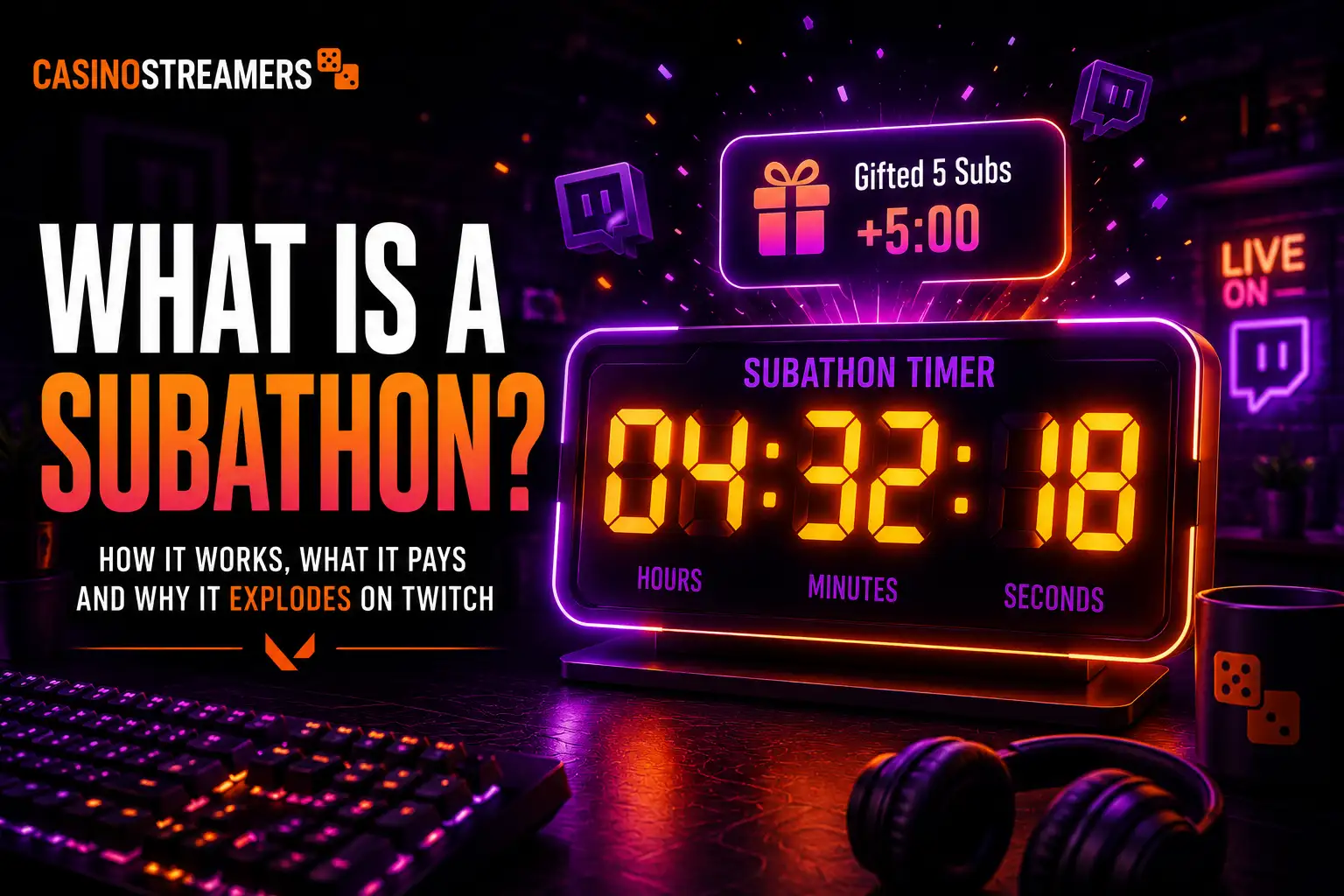
A subathon is a subscription marathon where every new sub adds time to a live countdown. When the timer hits zero, the stream ends.
The mechanic is almost insultingly simple. A timer ticks down. You subscribe. It goes back up. That is it. And yet Ludwig ran for 31 days on it and grossed over $1.4 million. Kai Cenat reached 1 million active Twitch subscribers during Mafiathon 3 in September 2025. Emilycc has been live for over 1,600 days because her community has never stopped feeding the clock. People will pay to feel like they are part of something, and a subathon makes that feeling visible in real time.
How a Subathon Works
Watch one for ten minutes and you will get it immediately. The timer is ticking down. Someone drops a gift sub. The clock jumps. Chat explodes. Everyone knows they just bought more stream.
Gift subs move the clock the most, bits nudge it and donations usually unlock whatever custom bonus the streamer promised. Most live streamers keep the timer on screen the whole time so nothing feels invisible.
Staying live for the entire duration is the commitment the format asks for.
That means eating on camera, sleeping on camera, occasionally just staring at the ceiling on camera. Ludwig spent roughly a third of his 31-day subathon asleep. His moderators kept the stream going while he slept and he still paid them for it. Turns out watching someone sleep on camera is more compelling than it sounds.
The one variable that determines whether a subathon works or dies is the cap. Most streamers set one between 24 and 48 hours, which keeps a finish line in sight and the urgency high. Skip it and the timer can bloat to 96 hours, at which point nobody feels the need to subscribe right now. Emilycc never set a cap and has been live for over 1,600 days, but she is also the exception that proves the rule. Most streamers are not building a 24/7 reality show.
Why Subathons Work So Well in Casino Streams
Casino streams have a pacing problem that most other categories do not. A dead bonus run can last an hour. The game does not care about your viewer count. A subathon gives the audience something to root for that exists independently of what the slots are doing. When the game goes quiet the timer is still there, still ticking, still something the chat can push back against.
The big win moments become doubly valuable in this format. A 5,000x hit mid-subathon does not just generate a clip, it generates a wave of gift subs that extends the stream and resets the energy. The content and the mechanic feed each other in a way that does not really happen in gaming categories where the action is more consistent.
Casino streamers on Kick have the best economics for it too. At 95/5 every subscription is worth nearly double what it pays on Twitch, and the casino audience already expects sessions that run for hours. The subathon just gives that endurance a purpose beyond grinding.
Subathon Earnings: The Top End and the Realistic Middle
Ludwig's 2021 subathon grossed $1,434,850 before deductions. After Twitch's cut, charity donations, moderator pay and taxes he profited $202,000. That gap is not a scandal, it is just how the money flows. Twitch takes 50% of subscriptions for most streamers, top partners can negotiate up to 70/30, and at $4.99 per sub the standard rate works out to roughly $2.50 per subscription before anything else comes out.
Kai Cenat reached 1 million active Twitch subscribers during Mafiathon 3 in September 2025, the all-time Twitch record. Smaller creators consistently report 2 to 5 times their baseline subscription rate during an active timer. For a full picture of how gambling streamers build income across formats, the how much do gambling streamers make breakdown covers it by level.
How to Run Your Own Subathon
Before anything else: a subathon is not something you log in and figure out as you go. If it works, you could be live for days. That requires planning, a moderation team, a sleep schedule and enough content ideas to fill hours of airtime without burning out on camera. The streamers who do it well treat it as a production, not just a long stream.
The tools are straightforward. TriBathon and Streamlabs both handle the timer, overlays and automatic time calculations. The decisions that matter are the variables you set before going live.
Setting the Variables
Start with 2 to 4 hours on the clock, enough runway to build momentum without feeling impossible to drain. Time per sub somewhere between 10 and 30 seconds keeps the timer moving visibly without ever feeling safe. A hard cap between 12 and 72 hours gives the whole thing a finish line to race toward. The single setting that kills most subathons is time per sub set too high. When each subscription adds 5 or 10 minutes the timer bloats, the clock shows 48 hours remaining and nobody feels any urgency to subscribe right now.
Making It an Event
A timer alone is not enough to hold attention for 12 hours. The subathons that generate real momentum layer in milestone goals, giveaways tied to the timer hitting certain points and challenges the streamer commits to completing before the stream ends. The timer keeps people watching. The content gives them a reason to subscribe right now rather than after the next bonus.
The best tools for new streamers covers the broader toolkit for building an audience alongside a subathon strategy.
References
- has been live for over 1,600 days (https://www.dexerto.com/entertainment/biggest-twitch-records-most-subs-longest-subathon-longest-twitch-stream-1710953/)
- Ludwig's 2021 subathon grossed $1,434,850 (https://en.wikipedia.org/wiki/Ludwig%27s_subathon)
- Kai Cenat reached 1 million active Twitch subscribers during Mafiathon 3 in September 2025 (https://www.dexerto.com/entertainment/kai-cenat-breaks-his-own-twitch-sub-world-record-during-mafiathon-3-3256431/)