

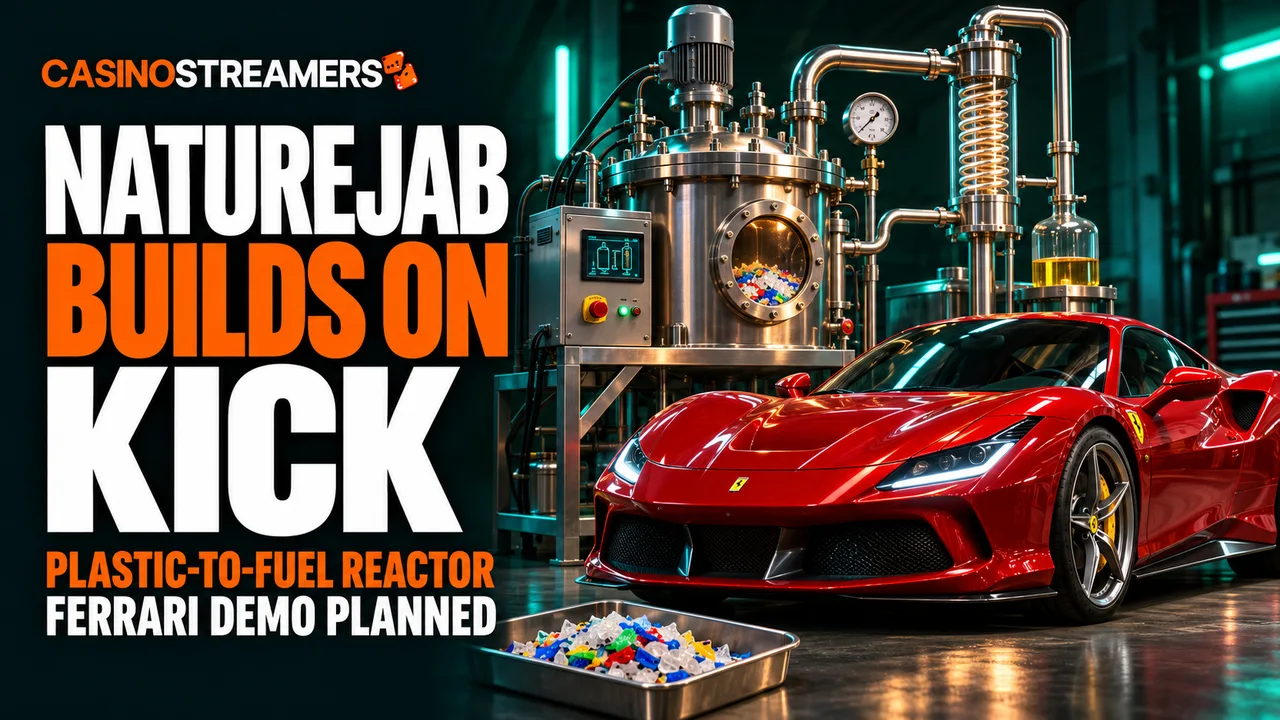
Julian Brown, the inventor and creator known as NatureJAB, launched a Kick stream titled "Mark Italia Begins" on November 9. The broadcast follows construction of Mark Italia 1, a reactor intended to turn waste plastic into a fuel Brown calls Plastoline.
The project's current schedule runs from November 9 to 28, with a demonstration using the fuel in a Ferrari planned for the final day. Construction is taking place near Modena, close to Maranello, the automaker's home.
What the demo still leaves open
The project page does not identify the car model or explain whether the demonstration will involve a stationary engine run or a drive. It also gives no test distance or performance target.
From a backyard reactor to Mark Italia 1
According to JAB Innovations' account of Brown's background, a video about ocean plastic caught his attention at 15. He built his first reactor in his parents' backyard at 17, teaching himself welding, chemistry and engineering. The organization says he has completed five generations of reactors and is developing a sixth.
His approach uses microwave pyrolysis to break plastic down into hydrocarbon vapor, followed by refining. In an April 16 interview on Earn Your Leisure, Brown explained the second stage: "You have to do another process called distillation."
What JAB claims about the fuel
JAB Innovations' technology page describes a process with "zero combustion" and "zero emissions," powered entirely by solar energy. It also describes the fuel fractions as "lab-tested at 110 octane." These claims have not been independently verified for this report.
The Italian project's October 23 update lists a natural gas burner to heat the distiller. That suggests the solar-only claim may not cover every stage of this build.
In its public FAQ, JAB says its priority is eliminating plastic waste and calls fuel "a useful byproduct." It also says ASAP Labs independently tested the fuel. The underlying lab report was not reviewed for this article.
Plastic pyrolysis is already the subject of extensive research. A 2023 study in Energy & Environmental Science modeled an industrial catalytic-pyrolysis plant and found that lower supply-chain energy use could coexist with higher greenhouse gas emissions than conventional chemical production. Feedstock preparation, energy demand and product separation affected its environmental and economic performance. That study examined a different process, not Brown's reactor.
Fuel production and fuel use also need separate accounting. Even without combustion inside a reactor, burning the resulting hydrocarbon fuel in an engine releases carbon dioxide, as the EPA's explanation of fuel combustion makes clear.
Where to watch the build
The full broadcasts are on NatureJAB's Kick channel, letting viewers follow assembly and preparation before the scheduled demonstration. A detailed daily broadcast timetable is still pending.
References
Related articles
 Stake Scrapyard 002 Brings 16-Fighter Boxing Tournament to Kick on November 22Nov 20, 2026
 GTA VI Launch Hits 7.9M Peak Viewers Across Streaming PlatformsNov 19, 2026
 Westcol Passes 5M Kick Followers as Stream Fighters 5 Sets Watch-Time RecordNov 18, 2026
 Kick vs Twitch GTA VI Giveaways: Dates, Codes and RewardsNov 17, 2026