

A streamer announces a “100x win”, yet the round only breaks even. Chat asks for “juice”, while the title advertises a “raw” session. Understanding a casino stream takes more than recognising the game's name.
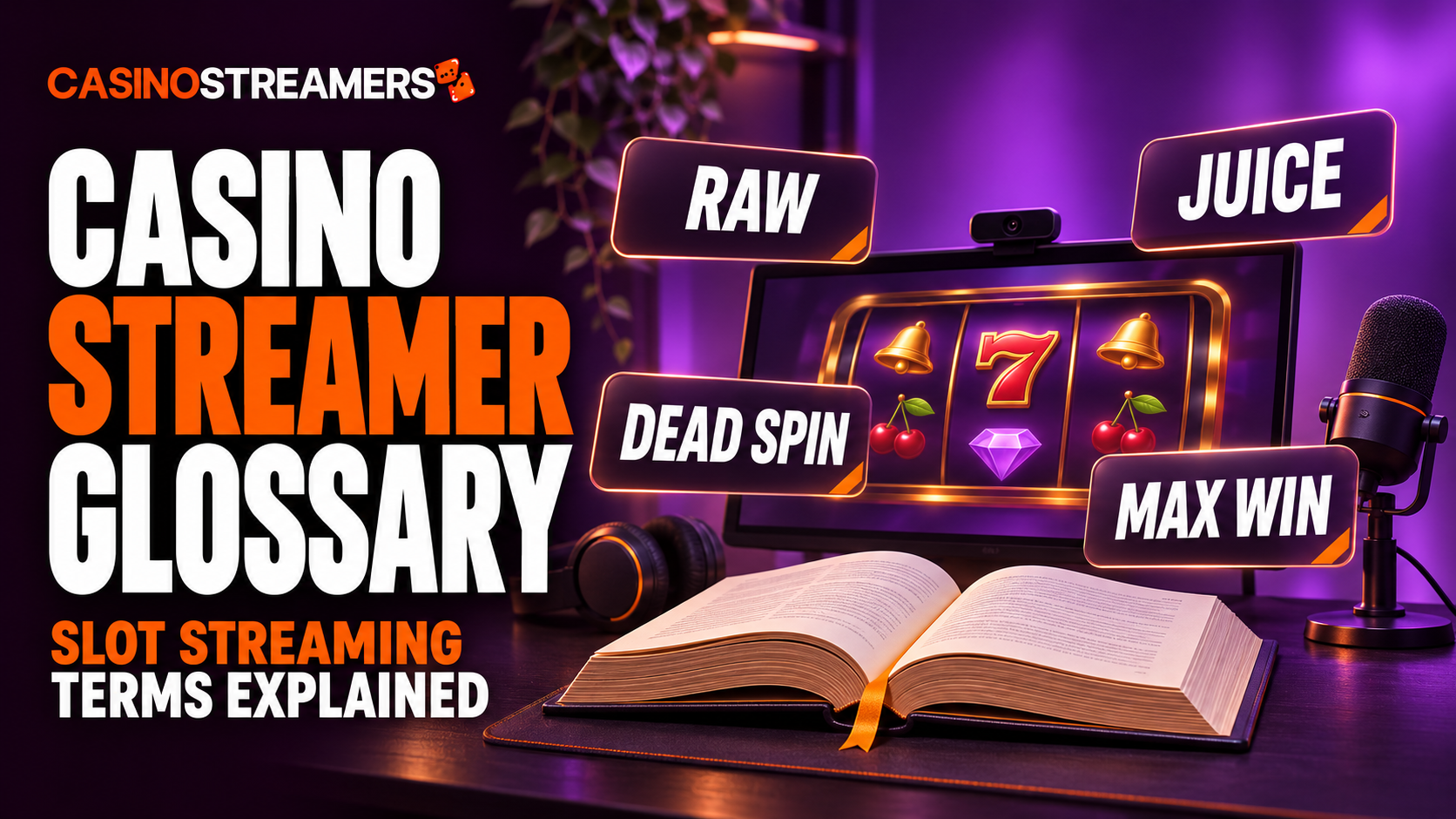
This casino streamer glossary explains the language used in slot streams, bonus hunts and highlight clips. Start with the four terms below, then use the examples to make sense of stakes, payouts and the numbers on a hunt tracker.
Term | Usual meaning on a casino stream |
Raw | Often a balance without a deposit bonus attached. “Raw spins” can also describe regular spins rather than bonus purchases. |
Juice | Money available to play with, additional funds, or an enthusiastic request for a bigger payout. Context decides. |
Dead spin | A spin that returns no payout. |
Max win | The game's stated payout ceiling for the relevant round or feature. |
The sample phrases and calculations below are illustrative. Named game examples use published provider information.
What Does “Raw” Mean in Casino Streaming?
A raw balance usually means money being played without an attached deposit bonus and its wagering requirements. A title such as “$1,000 raw” commonly describes the starting balance on that basis.
There are two separate questions here. Who supplied the funds? And what conditions apply to keeping or withdrawing them? The word “raw” cannot answer both.
For example, in an explanation reported by Dot Esports, xQc used “raw balance” to describe an arrangement involving his own money plus additional funds. Streamers' usage can be broader than the clean-deposit definition.
Consequently, “raw” in a title does not establish that a session is entirely self-funded or that every displayed dollar can be withdrawn without conditions. CasinoStreamers' guide to sponsored balances and streamer funding explains that distinction.
You may also hear raw spins used for ordinary paid spins, as opposed to buying direct entry into a bonus. That describes the play format. A streamer can use a raw balance to buy bonuses, or trigger bonuses through regular spins while playing with promotional funds.
What Does “Juice” Mean on a Casino Stream?
Juice is flexible slang for money, extra funds or the payout a streamer wants to see. The surrounding words are more useful than a single dictionary definition.
Example phrase | Likely meaning |
“We've got $500 of juice left.” | There is $500 left in the balance being discussed. |
“Can you juice the balance?” | A request to add funds. It does not identify whose money would be added. |
“Come on, give us some juice.” | A call for a better result or more action from the game. |
“Juiced” can similarly express excitement about a feature with large multipliers or an account with more money available. It is informal commentary, without a fixed numerical threshold.
There is also an established sports-betting meaning. Juice, or vig, refers to the bookmaker's margin built into the odds. That is a separate use from a slot streamer asking a bonus to pay more.
What Is a “Dead Spin”?
A dead spin normally pays zero. If a $1 spin returns nothing, the player loses the $1 stake on that spin.
A spin that returns $0.20 has produced a payout, but still leaves an 80-cent loss. That is why counting paying spins and counting profitable spins can produce different totals.
Chat also uses dead bonus more loosely for a disappointing feature. A bonus returning 20x after a 100x purchase pays something, yet loses 80 base-stake units. “Dead” is a reaction in that sentence, rather than an exact zero-payout description.
There is one naming trap. In Nolimit City's Dead, Dead or Deader, three scatters trigger a feature called Dead Spins. The name identifies a bonus round and does not mean that its spins all lose.
What Is a “Max Win”?
A max win reaches the payout ceiling specified in the game's rules. The limit is commonly expressed as a multiple of the base stake.
Hacksaw Gaming lists a 12,500x maximum for Wanted Dead or a Wild. At a $1 base stake, that corresponds to a $12,500 gross payout. The multiplier describes the size of the ceiling, without telling you the probability of reaching it.
A cap can apply to the combined result of a bonus round. Some games end the feature when that ceiling is reached, even with spins remaining. For example, The Knight King's published rules specify that a round ends at 5,000x and forfeits any remaining features.
Three nearby terms describe different things.
Term | What it tells you |
Max bet | The largest permitted stake for the relevant game or mode. |
Big win / mega win / epic win | A game's celebration label or a creator's description. Its threshold varies. |
Jackpot | A particular prize, which may be fixed or progressive. Its rules determine how it relates to any other payout cap. |
A “max win” claim therefore needs the game's actual limit. A large number or dramatic animation alone is insufficient.
Base Bet, Bonus Buy and “X” Explained
Base bet is the reference stake used to calculate many slot payouts and feature prices. The amount actually deducted can be higher when the streamer buys a bonus or activates a paid modifier.
X means “times”. In a result described as “100x”, it usually means 100 times the base bet. A multiplier symbol inside the game can work differently, applying to a particular line win or tumble instead. Check what is being multiplied.
Bonus buy, also called feature buy, means paying for direct access to a specified feature. Its price is often quoted in base-bet multiples. Hacksaw's own explanation of base bet and total bet uses a €200 Duel purchase with a €1 base bet as an example.
Here is a separate hypothetical bonus costing 100x on a $1 base bet.
Feature result | Gross payout | Purchase cost | Net result of that purchase |
20x | $20 | $100 | −$80 |
100x | $100 | $100 | $0 |
250x | $250 | $100 | +$150 |
That middle row explains how a “100x win” can simply recover the purchase price. Earlier bets still count when calculating the full session's result.
The interface may show the base stake, the purchase price or another total under a BET label. Identify the reference stake and actual deduction separately before interpreting a clip.
Bonus Buy Versus Boosted Spins
Ante bet, bonus boost and feature spins describe paid options that change a spin's setup. Depending on the game, they may increase the chance of a bonus or guarantee particular symbols.
A boosted spin need not guarantee entry into a bonus. For example, Spinman's published options include a 3x-cost spin with an increased bonus chance, alongside separately priced direct bonus purchases. The selected mode determines what the extra payment buys.
Bonus Hunt Vocabulary
A bonus hunt commonly involves collecting triggered bonus rounds across several slots, leaving them pending where the games allow it, and returning to play them together. The opening can therefore show bonus after bonus while omitting much of the paid play that collected them.
Term | Meaning |
Natural bonus | A feature triggered through spins rather than purchased directly. The spins used to reach it still cost money. |
Opening | Playing through the collected bonus rounds. |
Retrigger | Earning additional spins or another activation within a feature, under that game's rules. |
Average x / AVG X | An average of payout multipliers tracked during the hunt. Check which results the tracker includes and how it calculates the average. |
Break-even x | A tracker figure expressing the payout needed from the remaining bonuses to reach a target balance. It is a requirement, not a forecast. |
GTW / Guess the Win | A viewer prediction of the opening's result. Channels may define the target as total bonus payouts or the finishing balance. |
How to Read “Break-Even X”
Suppose a hunt starts with $500. After collecting six bonuses, all at a $1 base stake, the cash balance is $200. There have been no extra deposits, withdrawals, credits or fees, and none of the saved bonuses has been opened.
The six bonuses must return $300 in total to restore the original balance.
$300 ÷ 6 bonuses ÷ $1 base stake = 50x needed per bonus on average.
If the opening returns $240, the final balance becomes $440. The bonuses averaged 40x, and the hunt lost $60. Seeing six paying features does not change that accounting.
With mixed stakes, add the actual monetary payouts. A 100x result at $0.20 pays $20, while a 20x result at $5 pays $100. An unweighted average of their multipliers does not describe their financial contribution accurately.
Also check what an overlay calls “break-even”. A channel may use the original deposit, an adjusted balance including reloads, or a separately chosen target.
More Casino Streaming Terms You'll Hear
Term | Meaning in context |
Gamba | Internet slang for gambling. It can describe the stream category or a gambling segment. |
Bankroll | Money allocated to gambling. A displayed account balance may represent only part of it. |
Reload / top-up | Adding more funds. Include those additions when assessing the session's result. |
RIP / busted | Usually a reaction to a lost round, a failed bonus or an exhausted balance. The context establishes the scale. |
Printing | Slang for a run of payouts or apparent profit. It describes what is happening on screen, without predicting the next result. |
Tilt | Frustration or emotional agitation affecting decisions, such as increasing stakes after losses. |
Tease | An animation or symbol arrangement suggesting a feature might trigger, such as two visible scatters while the last reel is moving. |
Scatter | A special symbol often associated with triggering a bonus. The required number and positions depend on the game. |
Wild | A symbol that substitutes for eligible symbols to help form winning combinations. Its exceptions and extra effects depend on the rules. |
RTP, Volatility and Hit Frequency
These are game-math terms that often appear alongside the slang. RTP, or return to player, is the theoretical share of total wagers returned as prizes over a large volume of play. A 96% RTP does not promise that a particular $100 deposit will finish at $96. Total wagers include money staked again after a payout.
Volatility describes how widely results can vary. Games with the same RTP can distribute payouts very differently, and providers' volatility ratings are not necessarily comparable scales.
Hit frequency describes how often a qualifying paying outcome occurs, under the provider's definition. A payout below the stake can count as a hit while still producing a net loss.
RNG stands for random number generator, the system supplying random values used to determine game outcomes. A run of dead spins does not make an ordinary random slot's next spin “due”. Features with persistent meters or changing bonus states have their own rules, so the active game state matters.
CasinoStreamers' guide to RTP and real streamer sessions explains how those measures differ from a streamer's observed results.
References
Related articles
 Twitch’s October Audience Surge Puts Worlds and Creator Discovery in FocusNov 3, 2026
 Ibai’s La Velada Moves to Netflix in Exclusive Three-Year DealOct 27, 2026
 What Is RTP in Slots? What Real Streamer Sessions Can and Can't Tell YouOct 26, 2026
 Top 50 Gambling Streamers in 2026: The Biggest Names on Kick and TwitchOct 23, 2026